


Ubu Roi: How Alfred Jarry's absurd, toilet-brush wielding King still reigns supreme


Confusing the boundaries between tragedy and farce, the grotesque tyrant Ubu Roi wreaks havoc over a nonsensical 19th-century Poland. But why does his tale still shock audiences today?
In 1896, then 23-year-old Alfred Jarry premiered his play Ubu Roi (King Ubu) at the Nouveau-Théâtre in Paris, presented by the Théâtre de l'Œuvre company (founded by Aurélien Lugné-Poe). Although it wasn't particularly well received by its audiences.
As Père Ubu enters the stage in Act One, he exclaims "Merdre!", translating literally as shit-re or pshite, adding an 'r' to the expletive to sound more animalistic. And on opening night, it caused a violent fifteen-minute riot before the play even had chance to progress. Though of course, we must remember that this is 19th-century France. Theatre was exclusively for the bourgeoise, and Ubu Roi was written as an anti-establishment piece. This eruption of conflict was carefully enhanced by Jarry, planting friends in the audiences to pick fights with the upper classes and fuel their frustrations. It was unpredictable, but it was all part of his performance.
Alfred Jarry was remarkably ahead of his time, often regarded as a leading voice for Theatre Of The Absurd, despite the term itself being coined almost half a century later by Martin Esslin in his 1960 essay. Ubu Roi was a deliberate attack on the 'well-made play', and the trends of romanticism and melodrama.
Even the framework of political allegories hadn't been seen often on the world stage, where satire shocked French audiences away from passivity and encouraged them to engage. This was before the likes of Bertolt Brecht's The Resistible Rise Of Arturo Ui (1941) and Eugene Ionesco's Rhinoceros (1959). Late 19th-century France was highly volatile amidst the social anxieties of the fin de siècle, and the play's social stance caused Ubu Roi to be outlawed in French theatres. I'll leave it to you to decide whether it was banned due to its riots, or whether Jarry's authoritarian critiques hit a little too close to home...
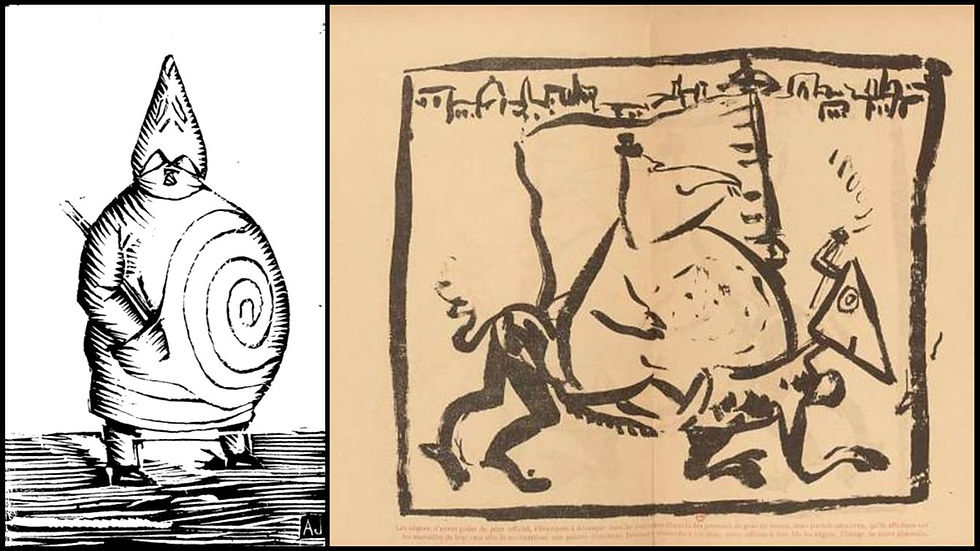
My first encounter with Ubu Roi was during my second year of university, as part of an avant-garde module. I read aloud the part of Père Ubu, and his vulgarity struck me the most. He eats practically everything in sight, represented by his 'gidouille' swirled belly. He is grotesque and cartoonishly obese, topped by a cardboard mask with unblinking eyes. And unforgettably, his toilet brush sceptre (pshite-stick) used to assault the nobility of Poland. The actor would perform Père Ubu like a kindergartener, controlling scenes with flimsy sets and marionette puppets. He is so far detached from humanity that audiences have little-to-no way of empathising with his character.
One of the play's greatest strengths however, is it's parodies of Shakespeare's stories. Père Ubu is urged by his wicked wife to assassinate King Wenceslas of Poland (Macbeth), then the ghostly king returns to demand his revenge (Hamlet) and a wild bear attacks Ubu and his followers (The Winter's Tale). By taking on respected Western literature, it takes our pre-conceived notions of familiarity where we recognise the references. Although it forces us to re-assess what we believe to know about the material, removing our complacency and forcing us to pay attention.
A warning to insatiable greed and the destruction of cultural norms, it's no wonder that Ubu Roi still holds immense power in the 21st century, with international appeal beyond its French origins. Père Ubu doesn't receive his comeuppance, and there is no justice against his evil acts. There's an eerie familiarity, isn't there? Through the most surreal of lenses, Alfred Jarry was able to unlock one of history's most unsettling political observations. And although cartoonish, we should all be fearful of Ubu...
Notable links and research:
Ubu Roi - Royal Court Theatre's Living Archive: https://livingarchive.royalcourttheatre.com/plays/ubu/
056. The Author of Ubi Roi - The Morgan Library and Museum: https://www.themorgan.org/exhibitions/online/jarry/56
The Twisted Legacy of Alfred Jarry's Monsters: https://www.thenation.com/article/culture/alfred-jarry-carnival-of-being-review/
Sebastian Trainor - Rachilde’s Supermale of Letters and the Invention of the Ubu Roi Riot: https://shorturl.at/IFFxn


