


The Trial Of Romeo Oscar Review: Ayckbourn's space-age courtroom asks the value of humanity

26 September 2026 | 14:30 | Stephen Joseph Theatre, Scarborough
⭐⭐⭐ | PR - Invite
By the year 2194, humanity may well have mastered interplanetary travel, and developed extraordinary androids that co-exist alongside us. Yet despite this technological process, The Trial Of Romeo Oscar asks one rather important question: what makes us human?
Presented at the Stephen Joseph Theatre, this play marks Alan Ayckbourn's 92nd original writing, which places a military issue android on trial for the murder of a girl named Juliet. What begins as a futurist courtroom drama gradually opens into something far broader, exploring consciousness, morality, memory, and whether artificial intelligence could ever understand the most complicated of human conditions - love.
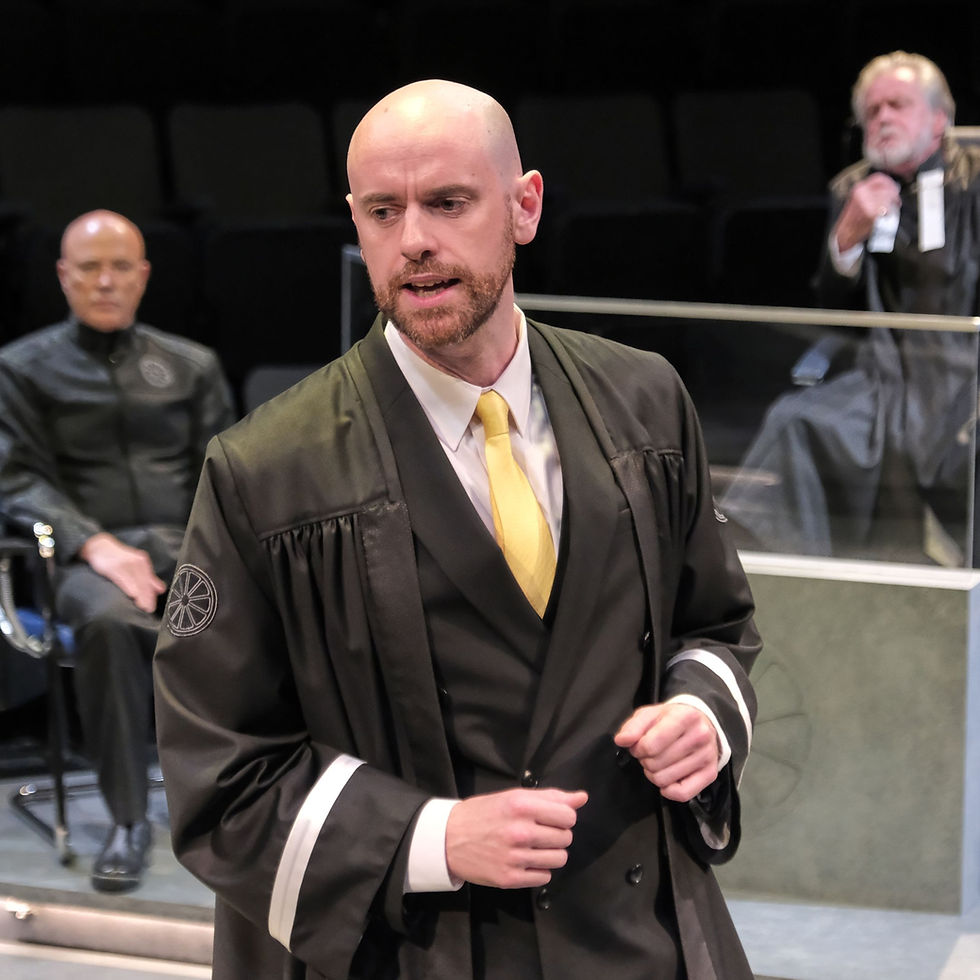
Actor Richard Stacey takes to the stage as RSDO 83 (or Romeo Oscar) whose connection with Juliet, the thirteen year-old girl in his care, is central to the case against him. In Act One, his carefully controlled physicality and costume create a convincing character, that we are watching something distinctly non-human attempting to operate within our world.

This portrayal weakens during Act Two, where a costume change removes his android-like appearance, and some of his distinctive robotic behaviour is also reduced. The intention may be to flip our perspective on how we perceive an android's actions, but we miss the clear visual separation between Romeo Oscar and the humans surrounding him.
The courtroom provides Ayckbourn with plenty of opportunity for wit alongside larger philosophical questions. Olivia Woolhouse, Leigh Symonds, Frances Marshall, Elizabeth Boag, Russell Richardson and Hayden Wood form a convincing ensemble around Stacey, handling a considerable amount of dialogue and future-forward terminology while keeping the relationships familiar.
The storytelling of the trial is essential to consider, and one creative choice leaves us feeling somewhat detached. A significant witness appears solely through audio, rather than physically entering the room, removing its immediacy. It may be a matter of personal preference, although an actor occupying the space may have created more dramatic advantage in such a pivotal scene.
The world of the production is visually believable. Kevin Jenkins' ultra-modern design is complimented by the below-stage effects and LED lighting, which change colour to reflect the shifting emotional tones of the story. There is also a strong sense of branding and identity in Jenkins' concept, which provide an official judicial setting. Alongside Mark Johnson's lighting design, it understands the play's futuristic weight without overwhelming the actors.

In some of the more intense scenes, vocal projection loses clarity due to the venue's in-the-round auditorium. The staging is quite inward facing, and in-the-round presents its own challenges of where to direct an actor's attention, thus losing occasional moments of dialogue.
Running at approximately 2hrs 35m, there is plenty to absorb here. Some sequences could be tightened, and the density of Ayckbourn's ideas come at the expense of the narrative. The production is generally well-executed, but with further precision and concision, the play could land with greater impact.
Almost 170 years into an imagined future, our society and conversations on love, truth and Shakespeare may not be so different to today. Ayckbourn's The Trial Of Romeo Oscar may sometimes lose focus, though it gives much food for thought on the future of the justice system. The play doesn't try and force us to accept an android's humanity, instead asking us which qualities give humanity its value in the first place.
Playing at the Stephen Joseph Theatre, Scarborough until the 3rd October, then tours to the Victoria Wood Theatre, Bowness-on-Windermere (13th - 17th October) and the New Vic Theatre, Newcastle-under-Lyme (21st - 31st October)


