


The Nightmare Room Review: an absurd minimalist thriller lacking in nuance


18 August 2026 | 19:30 | Nottingham Theatre Royal (Classic Thriller Season)
⭐⭐⭐ | PR - Invite
For Nottinghamshire theatre enthusiasts, August is a hotly anticipated month, as Tabs Productions take over Nottingham Theatre Royal for their annual Classic Thriller Season, performed in rep. Entering their second week of productions, we have The Nightmare Room, a psychological-suspense story by Arthur Conan Doyle. In contrast to their typically realist stagings, The Nightmare Room embraces minimalism, producing an oppressive and rather absurd two-hander.
At the centre of the room is a bottle of poison. When Helen regains consciousness, she finds herself bound and blindfolded in an empty room. Her best friend and captor Catherine initiates a deadly game of Russian roulette to decide who will 'win' the handsome film star they are both in love with. But between these walls, not everything is as it seems.
As an early 20th-century thriller, it features all the components you'd expect: elaborate twists and turns, an ending of Greek tragedy proportions, and plenty of blood! But it takes a while to get there.
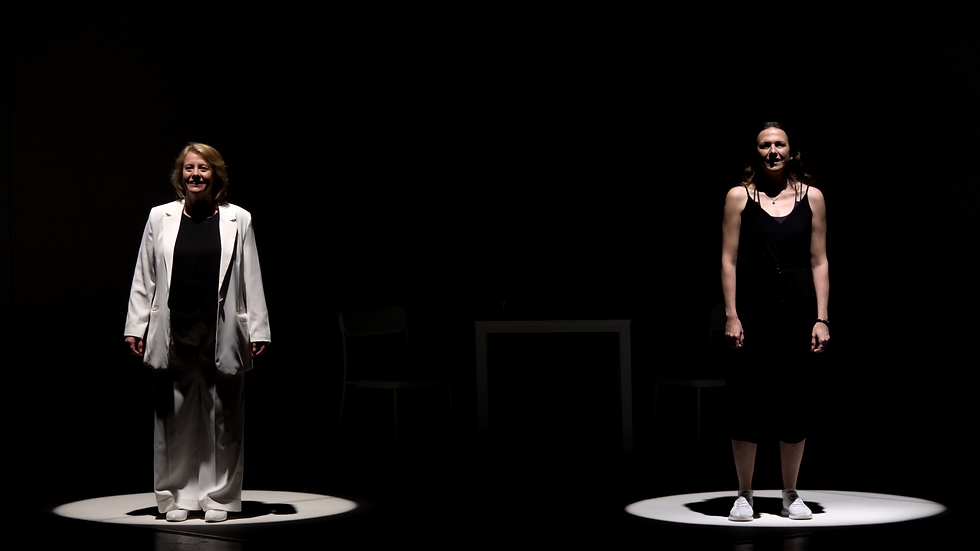
We begin at Helen's realisation that she is in the room. She is a woman who is very melodramatic and skittish, even after hearing the voice of her life-long best friend. Although this behaviour is later justified, their relationship in the present often feels like that of two strangers, rather than steeped in a decades-old history of friendship. Adapted for the stage by Rumpus Theatre's John Goodrum, the scripting is slightly pedestrian and lacking in nuance, as the women use 'bitch' in every scenario, and the dialogue becomes Real Housewives-y as they butt heads over a man.
Scattered between the present day are flashbacks to Helen and Catherine's earlier life, which are non-linear and occasionally confuse as to when they are. Some of these are strong in driving character backstory, notably as Catherine (Sarah Wynne Kordas) adopts different accents and has 'conversations' with her adulterate husband. Another sees the pair as young children playing a pretend version of Rumpelstiltskin. The down-ageing is quite awkward, though effective in establishing Helen's long-standing subordinance and wanting for revenge.
Sarah Wynne Kordas is more grounded as Catherine. Complimented by a sharp, white power suit, her presence holds such dominance. She is a real live-wire, and you never know what she'll do next. Corinne Begluk has some highlights as an allusive Helen, though the problem lies in that her character's motivations aren't grounded in logic. Audiences are treated to much less of Helen's past, in turn swallowing Begluk's performance up due to a lack of intention.

As earlier mentioned, flashbacks are difficult to place when they happen. But the where is always clear: window cut-outs for Catherine's home, diffused lights for a nightclub, and spotlights for isolated phone calls. Conal Walsh's clinically white box set (originally designed by Keith Tuttle) violently shifts under blackouts and unbearably bright white washes. It hurts the eyes, but its aggressive sensory nature, alongside deep throngs of sound, enhance the thriller experience.
Directed by Karen Henson, The Nightmare Room is too much of a contemporary revamp for its own good. It can slug along at times, but when it reaches its climaxes, it really is gripping. And through it all, you never feel disinterested, always keen to kind out what's coming next. We thought we'd predicted the ending twist during the interval, except it turns out we predicted Conan Doyle's original ending! Goodrum's adaptation puts a different spin on the short story, so if you think you know The Nightmare Room, think again...
Tabs Productions' The Nightmare Room plays until 22nd August, followed by The Mantrap (25th - 29th August), a premiere production of the French thriller Piège pour un homme seul:


