


Eugene Onegin Review: an accomplished production of Tchaikovsky's emotionally charged opera


09 October 2026 | 19:00 | Leeds Grand Theatre (North England Tour)
⭐⭐⭐⭐ | PR - Invite
If ever there were an argument for getting your timing right, Eugene Onegin may just be it.
Opera North's new production of Eugene Onegin, led by Tchaikovsky's sumptuous and emotionally charged score, opens tonight at Leeds Grand Theatre ahead of a short tour. With a sweeping live orchestra and chorus, audiences absorb a story filled with love, rejection, pride and missed opportunities.
We begin by meeting Tatyana, an introspective young woman against the backdrop of a re-imagined 1980s Russia. She falls hopelessly in love with Eugene, a dashing, cynical man. But as the political landscape of Russia shifts underneath their feet, Tatyana is a different woman, finding love in a more fashionable society. Eugene's love for Tatyana blossoms too late, and the pair's lives are changed forever.
At the centre of the tale are John Brancy's Eugene Onegin and Verity Wingate's Tatyana. Wingate charts Tatyana's journey from an emotionally wistful woman, convinced she has met the man of her dreams, into someone altogether more assured. Brancy gives Onegin the necessary confidence and detachment while ensuring an unfortunate humanity lies underneath, upon discovering that his love is no longer obtainable.

Caspar Singh also impresses as Lensky, a close and passionate friend of Eugene. Bringing an authentic emotional arc to a such a tragic character, the principal performances are strong throughout, supported beautifully by the Opera North ensemble.
Originally set in the 1820s, Patrick Nolan's direction relocates the action to a more immediate 1980s Russia, with Leslie Travers' set substantially filling the Leeds Grand Theatre stage. Resembling an institutional hall or gymnasium, it features doors, an upper-level balcony and two colossal staircases, which are continually repositioned to create different spaces. Its scale is striking, yet versatile enough to transform with the evolving story.
Maxine Braham's choreography is measured and purposeful, using the large company effectively to give the ensemble a strong sense of flow. Larger scenes are carefully shaped without feeling overcrowded, although the show could benefit from welcoming a little more dance - particularly given its Russian culture, to offer more colourful layers to social scenes.
Most importantly, this emotionally intense energy doesn't falter when the stage empties out. In smaller scenes with only a handful of performers present, the space suddenly feels vast and exposed, allowing the emotions to sit more heavily in the room. These stripped-back moments create a powerful contrast to fuller ensemble sequences, giving the principal characters nowhere to hide.
One less successful visual involves a series of coloured square boards, repeatedly positioned around the staircases. Their purpose is not always clear, and ultimately attracts the eye to something that doesn't add a great deal to Nolan's storytelling. However, suspended LED rope lighting is a contemporary highlight in another scene, offering a splash of vibrancy after a considerable period of stark, white illumination.
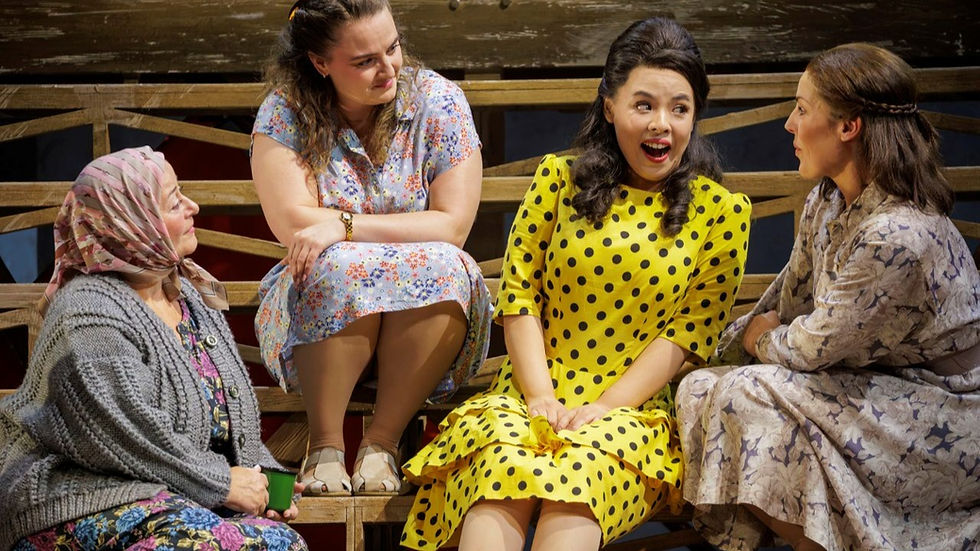
In Act Three, Malcolm Rippeth's lighting design is powerful in the introduction of a mammoth, chandelier-like feature lowered above the action. It instantly adds a great sense of occasion, helping these later, wealthier scenes feel visually distinct from those before. Assisted by Elizabeth Gadsby's glamorous costumes in the soirée, creating a beautiful well-rounded picture.
For all of its romance and geniality, Eugene Onegin is far from a simple romance. Death, grief and gun violence sit alongside passion, as the increasingly tense confrontation between Onegin and Lensky provides one of the evening's most gripping scenes. Staged with a Russian roulette-like tension, it's guaranteed to have audiences on the edge of their seats as the atmosphere inevitably tightens.
Through it all lies Tchaikovsky's extraordinary music. Under conductor Garry Walker, the live orchestra gives the score tremendous richness and identity, often expressing the sentiments that the characters cannot speak themselves. Almost as if the orchestra were another character in the room - carrying desire and regret under the moments that are non-spoken.
Performed across three acts (approx. 3hrs 10 with two intervals), the opera can occasionally feel lengthy. Certain passages take the scene route, when a more direct journey would serve them better. Perhaps some careful trimming would tighten the production without sacrificing its emotional depth.
Given this was its first performance, its execution is remarkably slick, as Eugene Onegin holds itself to a commanding standard. A thought-provoking story set against a more progressive social backdrop, we begin Opera North's 2026-27 season with a most accomplished new production.
Playing at Leeds Grand Theatre until the 29th October, before touring to Newcastle, Salford and Nottingham: https://www.operanorth.co.uk/whats-on/eugene-onegin/


